← Blog · August 5, 2026 · Dekopon AI
The Rainiest Car Wash Markets in America
We measured five years of hourly weather across the 30 biggest car wash markets — counting only rain, during operating hours. Then we looked at what it does to the phone.
“What if it rains?”
It’s the first thing car wash operators ask us about AI customer support, and it’s a fair worry. If your crew shuts the tunnel down at one o’clock and the phone keeps telling people you’re open till six, you’ve turned your own phone line into a machine for sending customers to a locked gate.
That’s why we built our AI to notice what a person behind your counter would notice — the weather outside that specific store, the local time, the language the caller is speaking, and more. And here’s the real impact, across the major car wash markets in America.
How often the sky overrules your sign
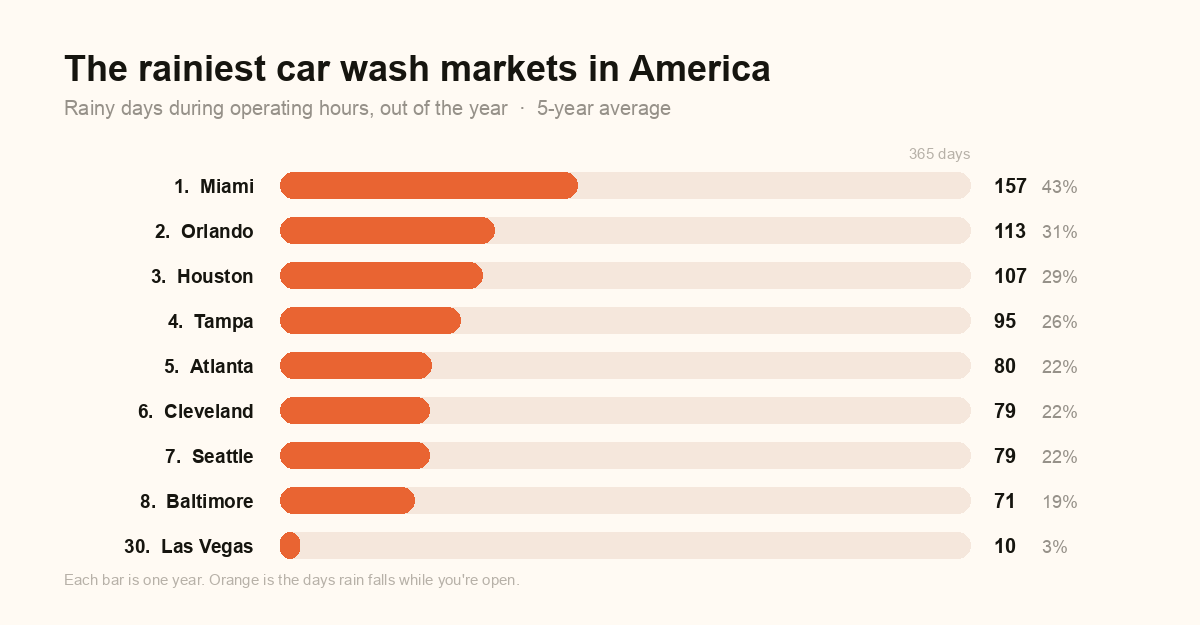
Rainy business-hour days per year — days with rain falling between 9am and 5pm local, averaged over five years:
| # | Market | Rain days | % of year |
|---|---|---|---|
| 1 | Miami, FL | 157 | 43% |
| 2 | Orlando, FL | 113 | 31% |
| 3 | Houston, TX | 107 | 29% |
| 4 | Tampa, FL | 95 | 26% |
| 5 | Atlanta, GA | 80 | 22% |
| 6 | Cleveland, OH | 79 | 22% |
| 7 | Seattle, WA | 79 | 22% |
| 8 | Baltimore, MD | 71 | 19% |
| 9 | Austin, TX | 69 | 19% |
| 10 | Washington, DC | 68 | 19% |
| 11 | New York, NY | 66 | 18% |
| 12 | Cincinnati, OH | 65 | 18% |
| 13 | St. Louis, MO | 65 | 18% |
| 14 | Boston, MA | 62 | 17% |
| 15 | San Antonio, TX | 62 | 17% |
| 16 | Dallas–Fort Worth, TX | 61 | 17% |
| 17 | Chicago, IL | 60 | 16% |
| 18 | Philadelphia, PA | 59 | 16% |
| 19 | Charlotte, NC | 56 | 15% |
| 20 | Detroit, MI | 56 | 15% |
| 21 | Kansas City, MO | 51 | 14% |
| 22 | Minneapolis, MN | 43 | 12% |
| 23 | Oklahoma City, OK | 41 | 11% |
| 24 | San Francisco–Oakland, CA | 38 | 10% |
| 25 | Riverside–San Bernardino, CA | 25 | 7% |
| 26 | San Diego, CA | 25 | 7% |
| 27 | Denver, CO | 24 | 7% |
| 28 | Los Angeles, CA | 22 | 6% |
| 29 | Phoenix, AZ | 15 | 4% |
| 30 | Las Vegas, NV | 10 | 3% |
A few markets worth pulling out.
Florida owns the top of the table. Miami, Orlando and Tampa take three of the first four places. This isn’t drizzle — it’s the afternoon convective storm that builds over the peninsula almost daily in summer and lands squarely in the middle of the operating day. A Miami operator deals with this 43% of the year: two days out of every five, the sign on the door is a guess.
Texas is really two markets. Houston sits third at 107 days, pulling Gulf moisture all summer. Dallas–Fort Worth, four hours up the road, gets 61 — a little over half as much. Austin and San Antonio land in between. Same state, often the same chain running stores in both, and the phone behaves completely differently at each end.
Southern California barely has the problem. Los Angeles gets 22 rainy operating days a year, Riverside–San Bernardino 25, San Diego 25 — and Las Vegas, at the very bottom, just 10. In these markets your posted hours are almost always right, which is exactly why operators expanding east are caught off guard: the same playbook that worked fine in LA breaks in Orlando.
The Northeast corridor is steady rather than dramatic. Baltimore 71, Washington 68, New York 66, Boston 62, Philadelphia 59 — no monsoon season, no obvious pattern, just a wet day every five or six days, all year long.
The spread from top to bottom is nearly 16×. In Las Vegas the sky overrules your sign ten days a year. In Miami, 157. The same answering machine is deployed in both.
And nobody gets to opt out entirely. Even down at 24th place, the Bay Area still sees this about three times a month — enough that “we’ll just tell people our posted hours” is never quite a complete answer anywhere.
Then the phone rings
Here’s what those days look like from behind the counter: the phone starts going. Grey skies don’t just close you. They make your phone ring.
And here’s the part that decides whether an AI is any good at this.
Sometimes “are you open?” really is just a question about your hours. On a grey afternoon, it usually isn’t — it means if I drive over there, am I wasting my trip? But almost nobody says that second part out loud. They just ask whether you’re open and leave the worry in their head.
So the agent has to answer what they meant, not what they said.
An answering machine only ever hears the words. “Eight to six.” Technically correct, and no help at all.
What someone standing in the building would say
“We’re open till six — but it’s been coming down since noon, so we might close early. Want me to check with the store?”
Same question. Completely different answer. The difference isn’t the script — it’s that the person answering glanced out the window first.
That’s the whole design. Before Emma, our AI phone agent, answers anything about your hours, she checks live conditions at that specific store — and answers one of two ways:
Your policy is the part that makes it yours, because “it’s raining” doesn’t mean the same thing at every wash. One operator we launched this summer runs it like this: light rain, they stay open. Sustained rain, they close early for the day. That distinction is in what the agent says. It doesn’t just know the sky — it knows the house rules.
The tuning matters as much as the lookup. Too twitchy and it hedges on a grey-but-dry Tuesday, talking customers out of a wash you’re wide open for. So a cloudy sky doesn’t count, and neither does an overnight shower that’s gone by opening — only rain actually landing during the hours you’re trying to run. And when it truly can’t call it, handing the caller to someone standing in the building is the smart answer, not a failure.
The clear-weather branch is the same understanding pointed the other way. On a good day the unspoken question isn’t “am I wasting my trip?” — it’s “should I bother today?” So the agent tells them it’s great weather for a wash and invites them in. Nobody scripts that; it only works because it knows what today actually looks like outside your bay. An answering machine says “eight to six” on both days, and is useless twice.
The same skill, everywhere else
Weather is just the example operators ask about first. It’s one instance of a general habit — answering the question people actually asked, not the one they literally said.
- They said “hello,” they meant “will I be able to get help here?” Spanish-speaking callers often open in cautious English, unsure whether asking in Spanish will get them anywhere. The agent switches from the first word — and those callers turn out to be disproportionately your paying members.
- They said “what are your hours,” they meant “can I still make it?” At 8:47pm nobody wants the weekly schedule recited. They want yes or no, and when you close — from the real current time at that location.
- They said “transfer me,” they meant “solve my problem.” If the store line doesn’t pick up, the agent comes back on, says it couldn’t reach the team, and takes the message itself instead of leaving them in silence.
- They said “do you do detailing?”, they meant “where can I get my car detailed?” At a multi-site brand, it points them to the sister location that actually offers it rather than saying no.
Meet Emma
Emma is Dekopon’s AI customer support agent for car washes — every inbound call, 24/7: hours, pricing, memberships, billing, cancellations. In your caller’s language, with your wash’s real information, handing off to your team when someone needs a human.
And on 157 days a year in Miami, she looks outside first.
Book a 15-minute demo — call the line on a grey day and ask if we’re open.
Know an operator whose phone is still reciting hours in the rain? Forward this to them.
Notes on method: rainy business-hour days are days with at least 1mm of rain falling between 9am and 5pm local time, averaged over the five years to July 2026, from hourly reanalysis data at each market’s center point. Snow is excluded — it’s a different operational question for a car wash, and including it overstated northern markets by as much as 29%. Markets are metro areas, not city limits — Miami covers Fort Lauderdale and West Palm Beach, Dallas–Fort Worth covers both. Market selection comes from Dekopon’s census of 28,260 US car wash locations, taking the 30 largest by wash count; the rain figures are point measurements and don’t depend on where a metro’s boundary is drawn. Operator and brand names withheld.
Get our car wash industry reports by email
Pay, pricing, and operations data across America's car wash chains.
Or see what Dekopon's AI agents can do for your stores — book a demo →